


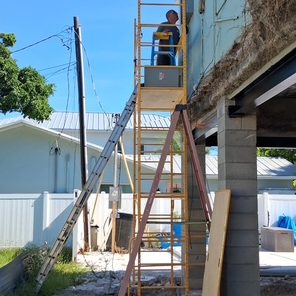
Home elevation and house lifting is becoming more common on Sanibel and Captiva, and you may have noticed a house or two propped up on tall wooden or steel supports while the new, taller foundation is built underneath it. If your home is next, you probably have questions. A big one we hear is, ‘What happens to my power and AC while the whole house is in the air?’
Good news. That’s our world, and we’re happy to walk you through it.
Why Are Sanibel and Captiva Homeowners Elevating Their Homes?
Home elevation, also called house lifting or house raising, is one way homeowners can better protect their homes from storm surge and flooding. For owners of older, lower-elevation homes, raising the existing structure may provide an alternative to tearing down and rebuilding.
It May Help Lower Your Flood Insurance
Raising a home may help bring down your annual flood insurance premium. Check with your insurance agent for your numbers, since every property and policy is different.
You Get to Keep Your Home
For a lot of homeowners, lifting is what makes it possible to keep the home they already love, the porch, the view, the memories, instead of a full teardown. It’s not the only path forward, but it’s often the one that keeps the most of what made you fall for the place to begin with.
What Happens to Your Electrical When a Home Is Lifted?
Before the house goes up, your electrical system needs to be safely disconnected. Once it’s set at its final height, everything gets reinstalled and usually extended.
Before the Lift: We Shut It Down Safely
We disconnect your electrical service, panel and circuits as needed so the house can move without damaging anything or putting anyone at risk.
It’s also important to get your electrician involved early. For home elevation projects on Sanibel and Captiva, LCEC recommends that homeowners or their electrical contractors provide advance notice before project completion to help avoid delays when it’s time to restore electrical service.
After the Lift: We Bring It Back Up to the New Height
Wiring gets reconnected and extended, and panels, meters, and outdoor equipment often need to sit higher to meet current requirements.
A home elevation is also a smart time to consider an electrical panel upgrade if your system is older, or add additional fixtures to make your home more convenient for you such as new outlets, lighting, or even an EV charger while everything’s already opened up.
What Happens to Your AC During a Home Lift?
Your HVAC system needs the same careful treatment before the lift begins.
Before the Lift: Disconnecting and Protecting Your System
Your air handler, condenser, refrigerant lines, and ductwork may need to come apart before the lift starts. Since a home can sit up in the air for months, it’s worth knowing what that means for your system and planning ahead to keep your equipment protected..
After the Lift: Reinstalling, Extending, and Elevating
Once the home is set, everything gets reconnected. Refrigerant lines, condensate drains, and ductwork may need to stretch to reach the new height, and this is also a smart time to consider raising your outdoor AC unit above the flood line.
Why Islanders Call Sanibel Air for Home Elevation Work
We live and work on these islands, so we know the codes, the salt air, and how quickly things change once storm season rolls around. We also work alongside your home elevation or house lifting contractor so your power and AC come off and go back on at the right time, without the runaround.
FAQs for Home Elevation on Sanibel and Captiva
Do I need an electrician when lifting a house in Florida?
Yes. Your home’s electrical service has to be safely disconnected before the lift and reconnected once the house reaches its new height. This isn’t something the lifting company typically handles on its own.
Can my AC stay connected while my house is being raised?
No. The air handler, condenser, refrigerant lines, and ductwork all need to be disconnected before the lift starts, then reconnected and often extended once the home is set at its final elevation.
Does raising my house mean my ductwork and wiring need to be extended?
In most cases, yes. Once the home sits at a higher elevation, wiring, refrigerant lines, drains and ductwork may need to be extended or reconfigured to reach the new height.
Should I raise my outdoor AC unit when elevating my home?
It may be a good time to consider it, especially if your existing equipment is vulnerable to flooding. We can evaluate your current setup and help determine what makes sense for your home.
Planning a Home Lift on Sanibel or Captiva?
The sooner we’re in the loop, the smoother the whole thing goes. Give Sanibel Air & Electric a call and we’ll help you plan the disconnect, the reinstall, and everything in between.


